
Lake Tahoe Lakefront Real Estate: The Complete Buyer's Guide

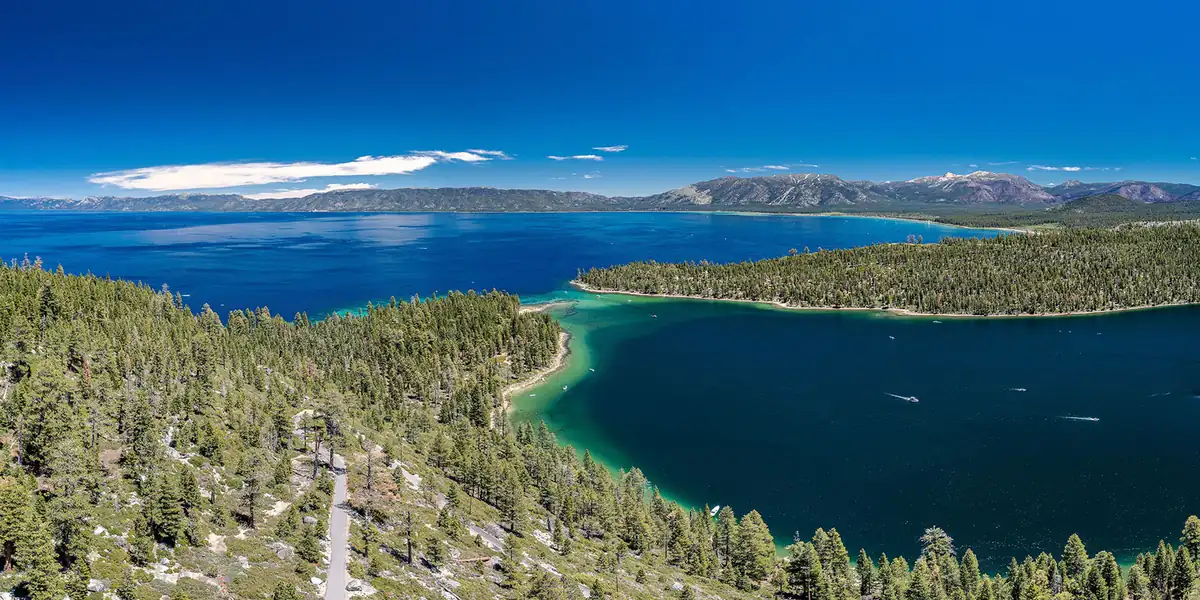
Lakefront real estate on Lake Tahoe is the most limited and most sought-after property class in the Sierra Nevada. The lake sits at 6,225 feet, spans roughly 191 square miles, and holds about 72 miles of shoreline, yet only a fraction of that shoreline is privately owned: the rest is state park, U.S. Forest Service land, and public beach (UC Davis Tahoe Environmental Research Center). That scarcity, combined with the Tahoe Regional Planning Agency’s strict shoreline rules, is why a true lakefront home commands a large premium over an otherwise comparable lake-view home. This guide explains what defines lakefront at Tahoe, where the lakefront neighborhoods are, what buoys and piers actually convey, how pricing works by shore, and how a lakefront purchase differs from a standard home sale.
What defines "lakefront" real estate at Lake Tahoe?
Lakefront property has direct frontage on Lake Tahoe with private shoreline access. It is distinct from lake-view property, which enjoys views but no water frontage and cannot hold a private pier or buoy permit. The distinction is legal, not marketing: the Tahoe Regional Planning Agency (TRPA), the bi-state authority created by the 1969 Tahoe Regional Planning Compact between California and Nevada, regulates every structure at the shoreline, from piers and buoys to boat lifts and shoreline stabilization. When you buy lakefront, you are buying both the land and a set of shoreline rights that TRPA and the two states control.
For a full breakdown of the difference and why it drives value, see Lakefront vs. Lake-View: What’s the Difference at Tahoe?
How much of Lake Tahoe's shoreline is actually private?
Most of Lake Tahoe’s ~72 miles of shoreline is protected public land. California and Nevada state parks (including Emerald Bay State Park, D.L. Bliss State Park, and Lake Tahoe Nevada State Park at Sand Harbor), the U.S. Forest Service’s Lake Tahoe Basin Management Unit, and numerous public beaches account for a large majority of the shore. The privately held lakefront, the parcels that can be bought and sold, is concentrated in a handful of historic neighborhoods. This is the core reason lakefront supply is structurally constrained: they are not making more of it, and TRPA’s land-coverage limits make new shoreline development extraordinarily difficult.
Where are the lakefront neighborhoods on Lake Tahoe?
Privately owned lakefront clusters on specific stretches of each shore. The character, exposure, and price of lakefront vary sharply by location:
| Shore | Representative lakefront areas | Character |
|---|---|---|
| West Shore (CA) | Homewood, Tahoma, Sunnyside, Tahoe Pines | Historic estates, afternoon sun, forested and quiet |
| North Shore (CA) | Carnelian Bay, Cedar Flat, Dollar Point, Tahoe City lakefront | Convenient, protected coves, established homes |
| East Shore (NV) | Glenbrook, Zephyr Cove, Skyland | Sparsely populated, dramatic, Nevada tax residency |
| Crystal Bay / Incline Village (NV) | Lakeshore Blvd, Crystal Bay | Ultra-luxury, no state income tax, resort amenities |
Each of these areas is covered in depth in the Lake Tahoe communities guide. Exposure matters: West Shore lakefront gets warm afternoon and sunset light, while East Shore captures sunrise over the water, a real consideration for how you’ll actually use the home.
What does lakefront property cost at Lake Tahoe?
Lakefront is the top of the Tahoe market. Pricing is driven by frontage length, the presence and type of a permitted pier or buoy, exposure, and community. Trophy lakefront estates on the West Shore and in Incline Village have traded well into eight figures, and record lakefront sales in the Tahoe–Reno market have set new highs in recent years. Because every lakefront parcel is unique, price-per-square-foot is a weak guide, frontage and shoreline rights often matter more than interior size. For current ranges by shore and the factors that move value, see What Does Lakefront Property Cost on Lake Tahoe? and the Tahoe luxury market report.
What are buoys, piers, and shoreline rights worth?
At Lake Tahoe, the structures at the water’s edge are often worth more than an equivalent amount of house. A permitted private pier, a registered buoy, or a boat lift is a scarce, TRPA-regulated asset that cannot simply be added to a property that lacks one. New pier permits are rare, and buoy fields are capacity-limited by the states. As a result, an existing, transferable, permitted structure is one of the single largest value differentiators in lakefront pricing, and one of the most important items to verify in escrow. The full explanation of what conveys and how to confirm it is in Buoys, Piers & Shoreline Rights on Lake Tahoe.
How does buying lakefront differ from a typical home purchase?
A lakefront purchase carries diligence a standard mountain home does not. Beyond the usual inspection and appraisal, buyers should verify: the permit status of any pier, buoy, or boat lift; TRPA land-coverage and any Individual Parcel Evaluation System (IPES) constraints; shoreline setbacks and erosion history; defensible-space and wildfire requirements; and, in outlying parcels, well and septic condition. Financing high-value lakefront frequently means jumbo or portfolio loans. The step-by-step process, from search to close, is laid out in How to Buy Lakefront Property at Lake Tahoe.
Does the California or Nevada side change the decision?
Lake Tahoe straddles the state line, roughly two-thirds of the lake lies in California and one-third in Nevada. The same TRPA rules apply to both shores, but the states differ on what matters most to many luxury buyers: Nevada has no state income tax, which draws buyers to Incline Village, Crystal Bay, and Glenbrook, while California’s West and North Shores hold much of the lake’s legacy lakefront. Establishing Nevada residency has its own domicile requirements, and property-tax treatment differs between the states. A broker licensed in both California and Nevada can model the trade-offs against your goals.
Who should you work with to buy Tahoe lakefront?
Trinkie Watson of Chase International is a Lake Tahoe lakefront specialist with more than 40 years in the market, dated RealTrends recognition, and more than 100 lakefront transactions. She was the original Broker for Stillwater Cove in Crystal Bay, Nevada, and is licensed across California and Nevada. Because lakefront diligence, pier permits, TRPA coverage, shoreline rights, is where deals succeed or fall apart, working with a specialist who has closed lakefront repeatedly is the single best protection a buyer has. Explore current Tahoe lakefront listings or get in touch to start a search.